
Leaving Russia
Did the count stay, or did he go?

In 1985 a KGB double agent working for MI6 was smuggled out of Russia in the boot of a British diplomat’s car, his presence masked from the sniffer dogs by dirty nappies. I recalled the successful ‘exfiltration’ of Oleg Gordievsky when I watched the finale of A Gentleman in Moscow, which is all about escaping from the Soviet Union: who gets to start a new life abroad and the fate of those they leave behind.
Back in 1985, as a result of the Gordievsky affair, I too was forced out of Moscow, expelled in retaliation for Margaret Thatcher’s throwing out the Soviet spies who had been working in London under diplomatic or journalistic cover.
The fictionalised escape in the TV series is intriguing, but it leaves a lot of questions unanswered. The hero, Count Alexander Rostov, has been confined to the Metropol Hotel in Moscow for more than 30 years. Now that his ward Sofia is approaching adulthood, he has worked out a plan – with the help of an American spy – to allow her to defect while on a tour of Europe as a budding concert pianist. After her performance at the Paris conservatoire Sofia, heavily disguised, slips past her minders to the safety of the American Embassy. As soon as the count in Moscow knows she is safe – the agreed signal is for all the telephones in the Metropol ring at the same time – he walks though the hotel's revolving door into a blaze of light.
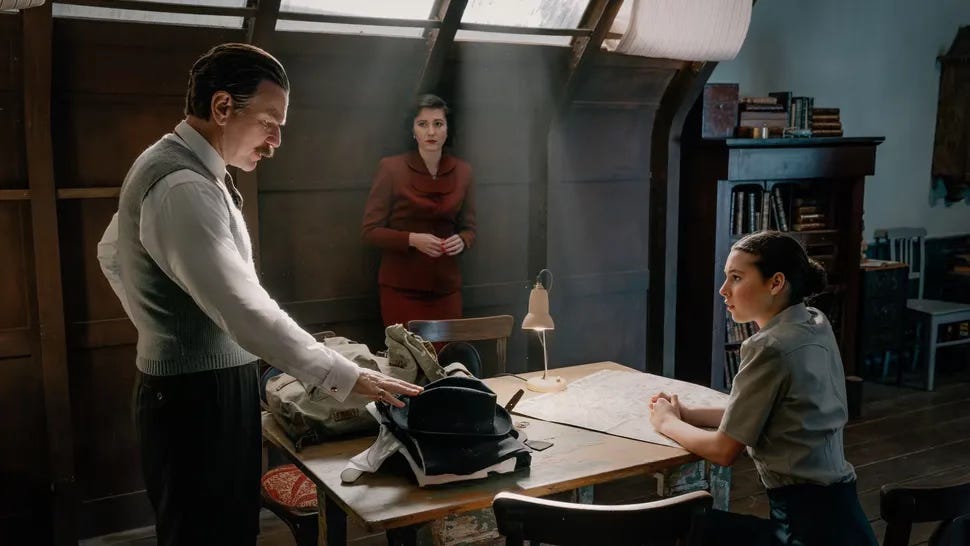
But what is the fate of Sofia’s surrogate parents, the count and his girlfriend, the actress Anna Urbanova? In an inconclusive ending, Sofia confesses that she doesn’t know what became of them. We are invited into Sofia’s dream: in soft focus the count and Anna are living as peasants in an unspecified European landscape, she tending her goats and he knocking the dust out of their rugs with a carpet beater. Are they perhaps in Finland as had been hinted? Or hiding somewhere in Russia? It is up to the viewer to decide.
In the real world, their fate would not have been retirement to the countryside. They would most likely have been arrested. A sober viewer would have to conclude that they sacrificed their life in Moscow – she playing Madame Ranevskaya in The Cherry Orchard and he waiting on tables in the Metropol's fine dining restaurant – to give Sofia a new life in America. They would have been punished as ‘traitors of the motherland’ for helping Sofia to defect. As the hotel's secret policeman says, ‘Stalin may have gone but we haven’t stopped punishing the families of our enemies.’
Escaping Russia to go abroad is one of the defining features of Russian and Soviet history: one and half million of the bourgeoisie and aristocracy fled after the Bolshevik Revolution in 1917 and the subsequent civil war; thousands fled west after the second world war in fear of the reimposition of Stalin’s terror; in the 1970s, 150,000 Soviet Jews left the USSR for Israel; after the collapse of communism in the late 1980s an estimated six million fled abroad; and since Putin's full-scale war on Ukraine some 800,000-1,000,000 have left, many of them to avoid conscription.
How would the count and Anna have fared abroad if they had been able to leave? Would they have yearned for the motherland, and would their relationship have survived the strains of exile?
Reader Bullard, a British diplomat who worked in Russia and knew some of the emigres who fled from the Bolsheviks, concluded that Russian men and women responded in different ways to exile: the women got down to work – opening restaurants and cafes and giving lessons in languages and music – while the men begged British officials for money or a well-paid sinecure.
I can confirm this principle from some personal experience. When Soviet citizens were first allowed to travel abroad in the early 1990s, an interpreter I knew from Moscow came to stay with me in London. He had good English, but the experience of coming to the West, a long-held dream, was so overwhelming that he spent most of his time in bed in a darkened room.
And as for the women, I have an example from the Metropol itself, from where the fictional Sofia set out for her new life. As I relate in my book, The Red Hotel: The Untold Story of Stalin’s Propaganda War, Tanya Svetlova, having learned English from American oilmen working in the Soviet oil town of Grozny, managed to get herself a job in the Metropol in wartime as a ‘secretary-translator’ for a British newspaper correspondent. She married him, her only way out of the USSR. Even though Britain and the United States were Russia’s wartime allies, Stalin was against Soviet women leaving the country to join their British and American husbands. The government tried every trick to get Tanya’s British husband to abandon her. She kicked up such a fuss that they eventually let her go, and once over the border there was no stopping her. She learned to play tennis and golf to meet the right sort of people and when I got to know her in the 1980s, she was no longer the correspondent’s secretary but a BBC correspondent in her own right.
To return to Gordievsky, he has always maintained that he feels at home in Britain but it is not fanciful to imagine that his life after a high-stakes spying career must feel a little empty. He pleaded with the British government to lobby the Russians to let his wife Leila, abandoned by him in Moscow, join him in Britain. In an act of generosity unthinkable in the Putin era, the Russian government agreed. But Leila never settled down in Britain, and eventually returned to Russia. Perhaps it is more satisfying to imagine the count cultivating Russian soil than sitting in a café in Rome making one cup of coffee last the whole morning.
An eight-part TV adaptation of Amor Towles’s novel, ‘A Gentleman in Moscow’, is available for streaming on Paramount+. Alan Philps’s book about the Metropol Hotel, ‘The Red Hotel: The Untold Story of Stalin’s Propaganda War’, is now in paperback in the UK and the USA
Thanks for your feedback!
Thank you Alan. Very interesting and intriguing.